





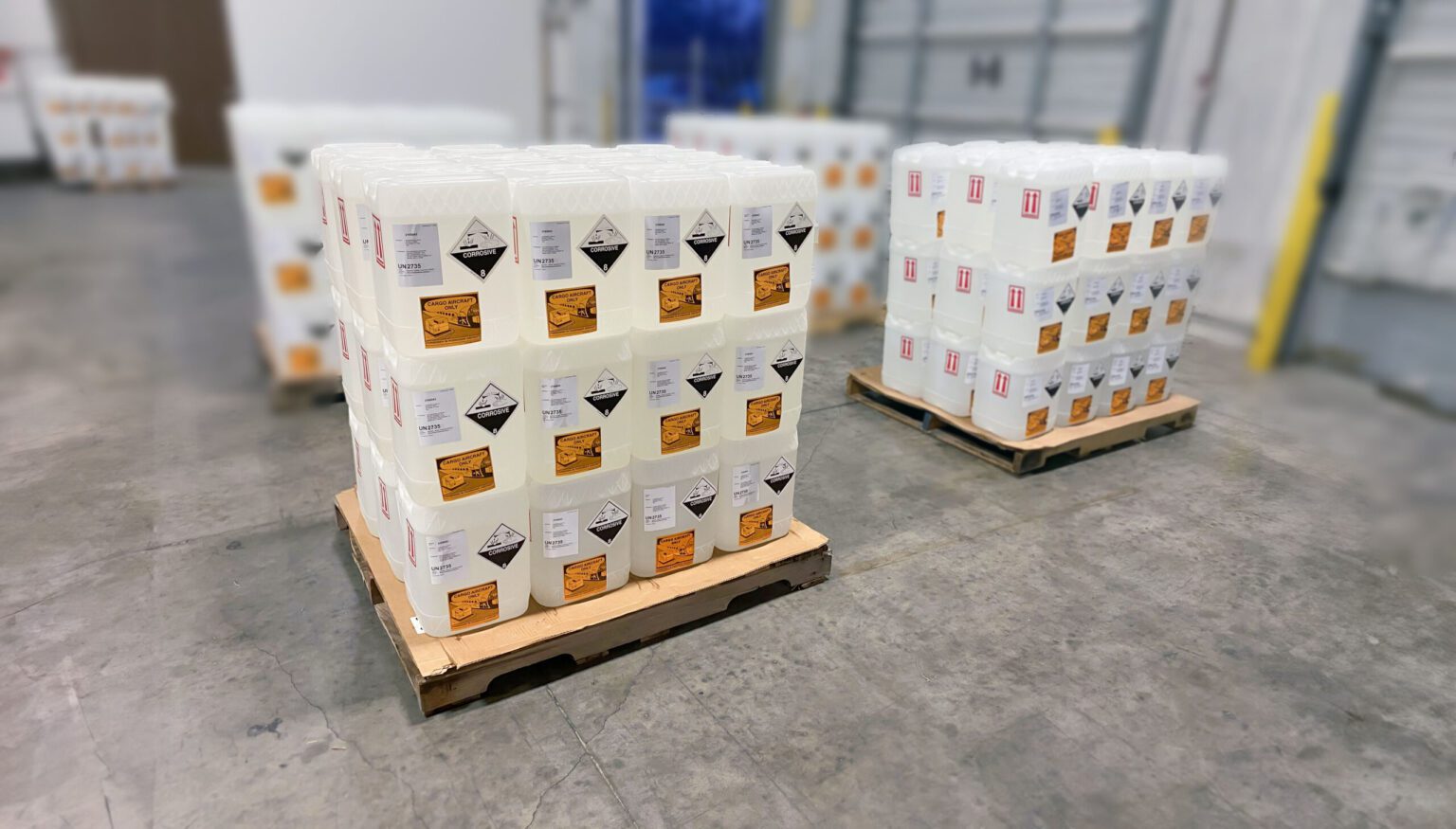
Chemical re-pouring
Some hazardous chemicals need to be moved into different packaging before they can move at all. We re-pour liquids under controlled conditions, using the equipment, protective measures, and practical care this kind of hazmat work demands.
When chemical re-pouring is needed
Chemical re-pouring is needed when a liquid can no longer stay in its current package or when the next handling or transport step requires a more suitable one. That may happen because the original container is damaged, the format is impractical, or the shipment has to be prepared differently before it can move on. In some customer environments, this may also be described as decanting or de-toting, but the underlying need is the same: controlled transfer into a more workable package.
Working under controlled handling conditions
Chemical re-pouring should take place under controlled handling conditions because the process itself introduces a point of exposure that ordinary warehouse tasks do not. The value of the service lies in reducing that exposure through the right equipment, protective measures, and practical discipline around the transfer. This is not a matter of moving liquid from one container to another casually. It is a controlled handling task with consequences if it is approached too loosely.
Choosing packaging that fits the next step
The package chosen after re-pouring has to support whatever comes next, whether that is storage, onward shipment, or another controlled stage in the process. That means the target package should be selected with the next movement in mind rather than simply solving the immediate container problem. A better package fit creates more value because it does not just complete the transfer. It improves the shipment’s readiness for the next operational reality.
Why this work calls for specialist care
This work calls for specialist care because the transfer moment concentrates both practical handling risk and downstream shipment consequence into one task. If the transfer is weak, the next step inherits the weakness. If the package choice is poor, the shipment may still not be workable after the transfer is complete. Good chemical re-pouring therefore depends on more than caution. It depends on handling knowledge that understands the full role of the transfer in the chain.
What chemical re-pouring makes possible
Chemical re-pouring makes it possible to move a shipment from an unsuitable packaging state into one that better supports storage, preparation, or onward movement. It can turn a blocked or weakened situation into a more manageable one by restoring packaging logic around the liquid involved. That is the real value of the service: not simply completing the transfer, but helping the cargo continue on a basis that is more practical and easier to support.
Every hazmat shipment poses unique challenges. We’re here to solve them.
From a single missing link to the entire chain: we determine what your shipment needs and handle those part of the process you’re looking to outsource. Practical, safe, and always in full compliance.
Why Special Cargo?
Special Cargo supports chemical re-pouring as part of wider hazmat shipment preparation rather than as an isolated liquid-handling task. Our team understands how transfer, packaging choice, and next-step readiness affect one another in practice. That helps us approach re-pouring with the level of control it deserves and align it more closely with what the shipment will need after the transfer is done, not just during the transfer itself.
How we add value with chemical re-pouring
Controlled liquid transfer: Hazardous liquids are moved under more deliberate handling conditions.
Better next-step packaging: The new container is chosen with storage or onward shipment in mind.
Useful for damaged or unsuitable packages: Re-pouring helps recover cargo that can no longer stay where it is.
Recognized across industry terms: The service fits needs often described as decanting or de-toting.
Stronger onward readiness: Transfer supports a more workable basis for whatever the cargo does next.